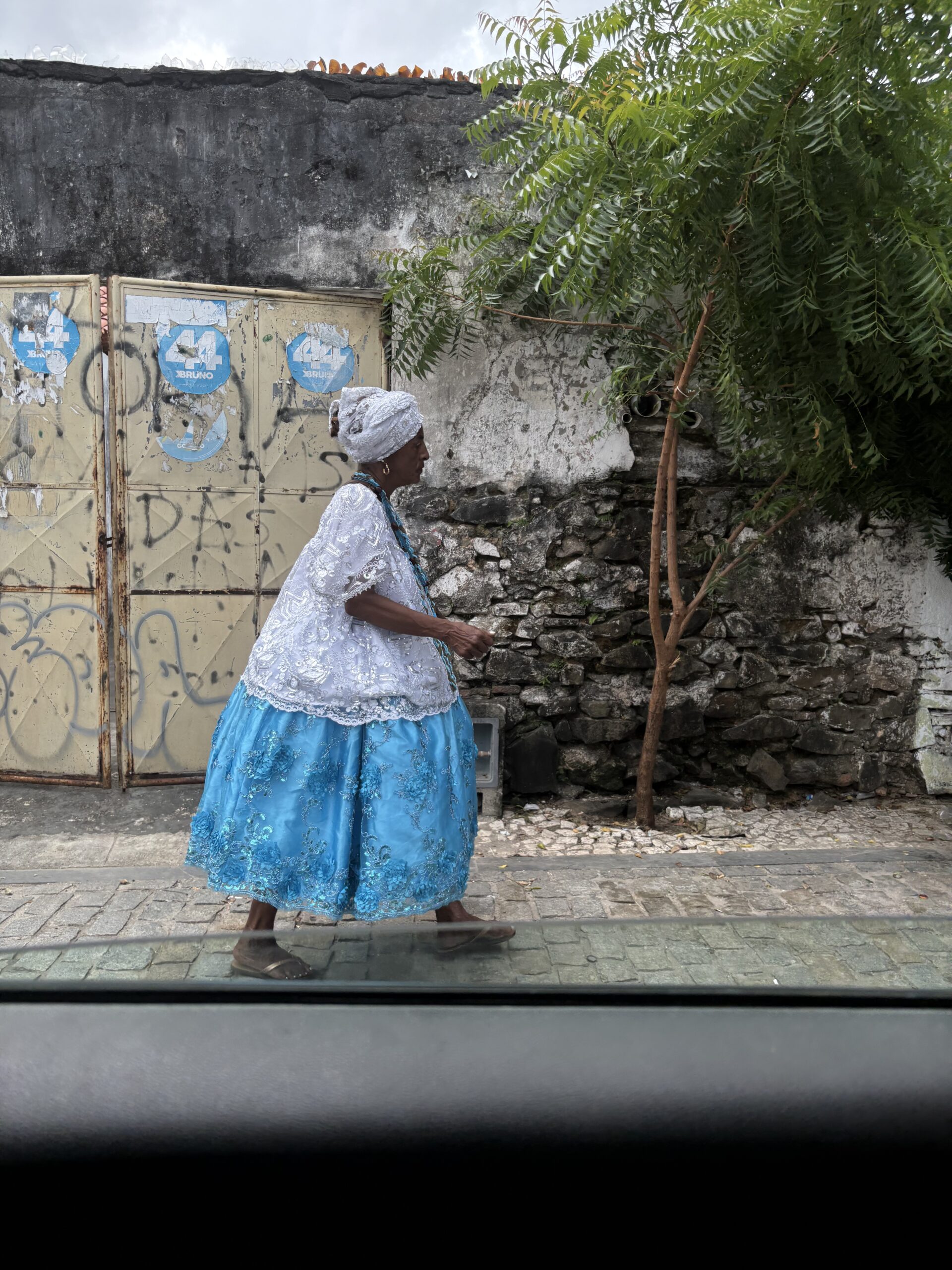
On my second visit to Pelourinho, I wanted to find out more, if I could, about the Bahianas. I was fascinated. My reading had explained who they are, how they influence life in Salvador, and how their beliefs are handed down from generation to generation. Having been brought up Roman Catholic, been baptised, received first holy communion, been confirmed, the whole shebang, this type of belief was unknown and fascinating to me.
About two years ago, work took me to New Orleans, where beliefs are also unlike my own. I was equally fascinated. Time constraints from work did not allow for finding out more and I hope to return one day to learn.
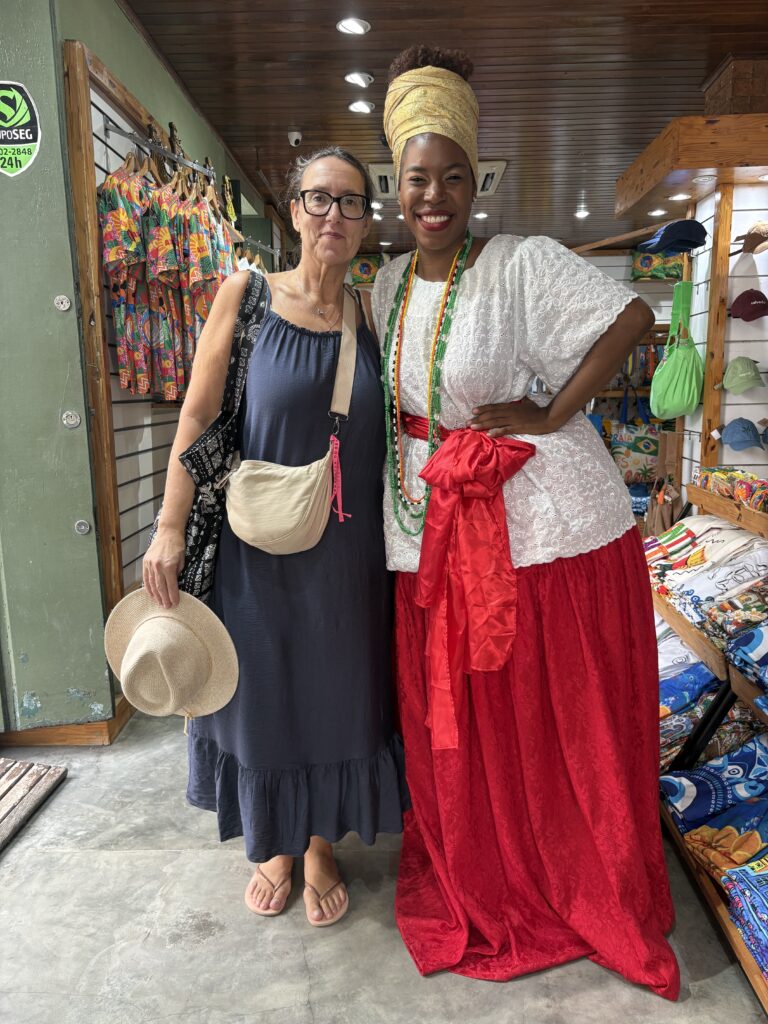
While wandering around Pelourinho, I spotted a beautiful young woman, dressed in red Bahiana gear, (they traditionally wear white) at the entrance to a shop. She smiled at me and gently ushered me in. I understood quite quickly that she was there for the tourists like me, to get them into the store to buy souvenirs and I wasn’t unhappy to get some relief from the heat. So, in I went, obviously.
I browsed, not really wanting to buy anything, but I did find a tote bag in the Brazilian colours – I can always use one of those. The till was being tended to by two young people in their early twenties; young man, young woman. The young man asked me if the tote bag was all I wanted. Was I not interested in purchasing an Orixá. A what, I asked? And so began a wonderful exchange, conversation, and learning experience for me. And how could it get better than having it explained to me by two young students. (They were earning money by working in the store in their free time, like so many students worldwide do). They reminded me of my own students back in Switzerland, although armed with significantly more enthusiasm, friendliness and willingness to explain.
So here it goes. It happened to be that the day I walked in to this shop, attracted by the beautiful Bahiana dressed in red, was the second of February, the day of “Iemanjá,” one of the Orixás. And today, of all days, was the Festa de Iemanja where thousands gather at the Rio Vermelho (Red River) to carry offerings to the sea. Iemanjá is the queen of the seas and oceans, mother of the Orixás, associated with motherhood, protection, fertility and emotional healing. I could not believe what I was hearing from these two young people. Seas and Oceans? Motherhood? Emotional Healing?
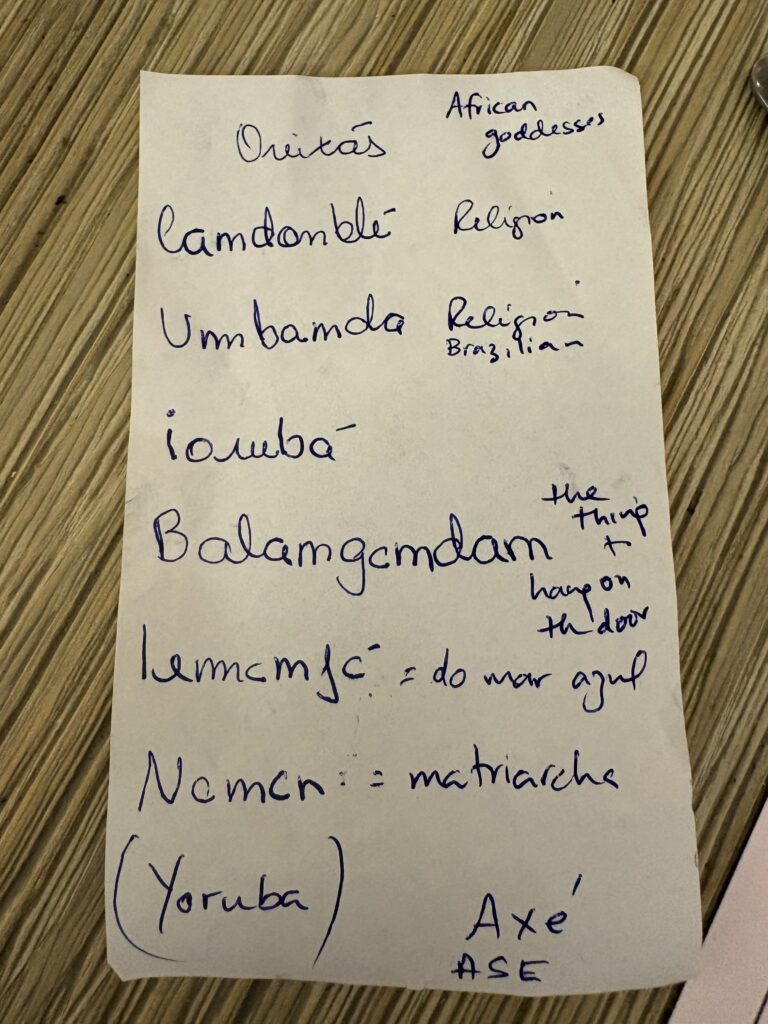
I asked more questions. They explained patiently. It’s part of “Candomblé,” they said. Words like Yoruba, Axé, Umbanda, Balamgamdam, Noman, were uttered. I asked them to write them down so that I could read and research more. My fascination only grew.
Why today, of all days, did I discover who Iemanjá was? That there were even Orixás? That I was in Salvador on the second of February? That Iemanjá protects people. It reminded me of how fate stepped in thirty years ago at Heathrow airport, on a trip to Guernsey towards the unknown and my future.
On the way back to the hotel, I asked the taxi driver to pass by the Dique do Tororó, a lake in the centre of Salvador known for its giant statues of the Orixás standing in the water.
I desperately wanted to go to the festival at the shore, to celebrate Festa de Iemanjá, but it was later that night, and I’m not very good late at night, not to mention, the hotel had expressly warned me not to go out after sundown, due to the crime.
I’m sure you’re not suprised to read that I ended up buying a Iemanjá statue, which now sits in my home office in Switzerland, to remind me that I am protected.
I have since read a great deal about the Orixá, the religion of Candomblé, originating out of Nigeria, the Yoruba nation, many of whose descendants live in Salvador, and how beliefs shape who you are.
I am grateful for these lessons.
Dates: 2nd February 2026


Leave a Reply