
The Azores, and particularly the island of Horta, is an island of whalers. There are outlooks all over the island where spotters would sit and stare out at the ocean for hours until whales were spotted, then call the alarm and out would head the whalers in a small boat with harpoons. Even whalers from the east coast of the United States would make it as far as the Azores in the hunt for whales. I have since come to read that the migration of many species of whales, but particularly sperm whales, passes close by.
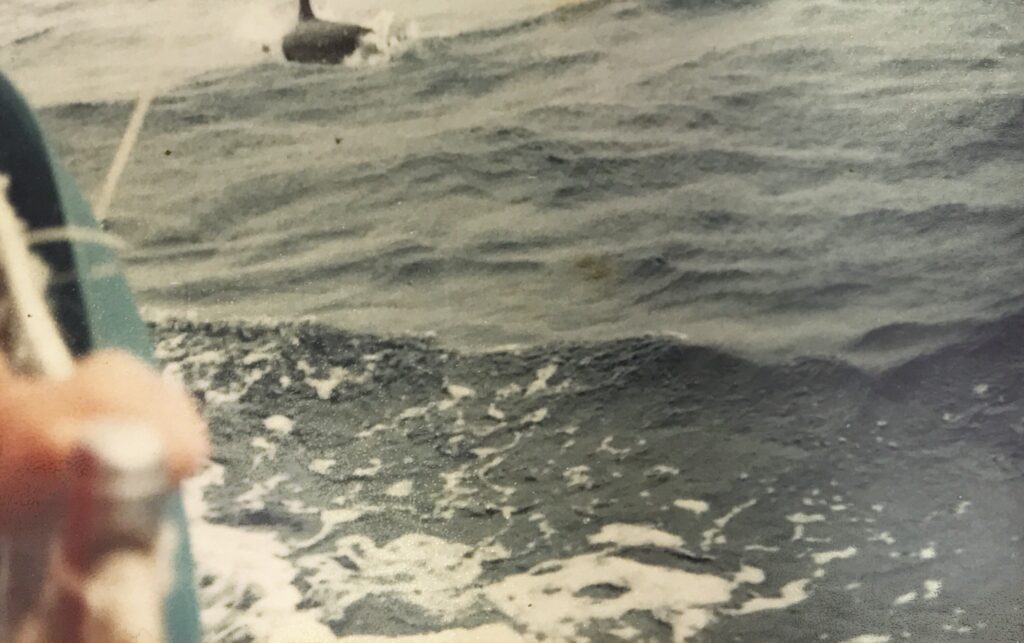
I do not know how many days or nautical miles before arriving in Horta that our whale spotting happened, but I remember it distinctly. I have a photo of a whale close by. It’s hard to see, but for me, it brings back all the memories of that scary but exciting day.
We now know that whales can and do attack sailing ships. Maybe my father knew that then too, but us kids certainly didn’t. We suddenly found ourselves in the midst of a pod of sperm whales, each one twice as long as Scally. They are slow and majestic. I don’t remember their eyes looking at us, although I’m sure they did, intelligent species that they are. I do remember their proximity to Scally, that I was frightened but in awe and I remember the smell of their spray when they surfaced. We were certainly very lucky that nothing happened to us or Scally.
In 1982, whaling had not yet been banned worldwide and it was still an industry in the Azores. Scrimshaw was a craft that was handed down from one Azorean generation to the next and much like my country of birth, where elephant tusks were also used for craft in statues, jewellry and other art; even though I am an owner of both, I am happy that both South Africa and Portugal, countries of my birthright, have banned and outlawed all hunting of these two magnificent species of animals.
Dates: 1982
Leave a Reply